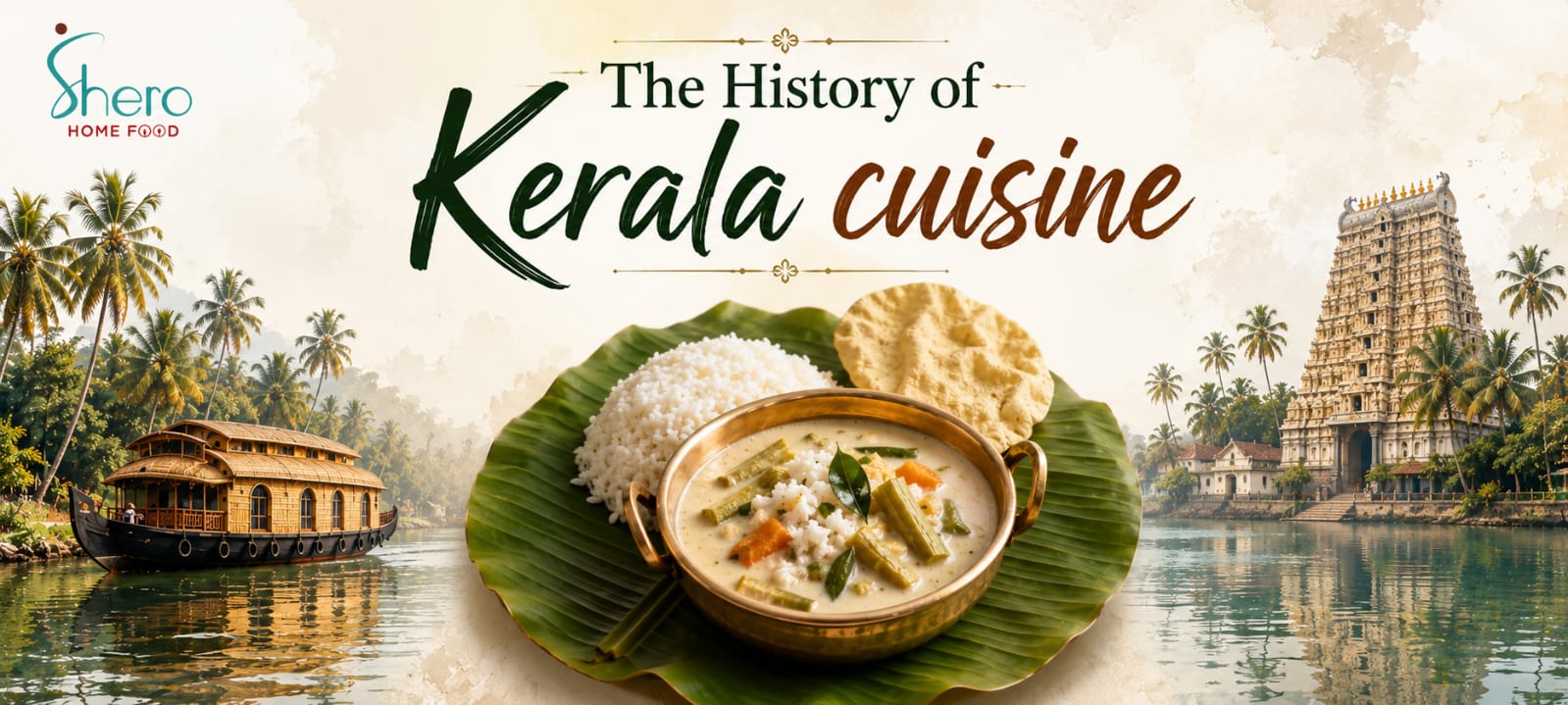
Kerala cuisine grew out of one of history’s most valuable trade corridors, the Malabar spice coast, where coconut, pepper, and fish met centuries of Arab, Chinese, Jewish, and European contact to produce a cooking style unlike anywhere else in India. Known for the Onam sadhya, appam, puttu, and fish curries built on coconut and tamarind, this cuisine has a large, established diaspora in the US, yet authentic Kerala food delivery remains hard to find for Malayalee families across Maryland.
If you’ve been searching for kerala food near me, the story behind that craving goes back centuries. If Chettinad food announces itself with heat and Andhra food doubles down on chilli, Kerala cuisine works differently: it layers. Coconut, curry leaves, mustard seed, and a careful hand with spice build flavor gradually rather than all at once. That restraint has a long history, one written by traders, not just cooks.
Where Did Kerala Cuisine Originate?
Kerala cuisine comes from the Malabar Coast of southwestern India, a narrow strip of land wedged between the Arabian Sea and the Western Ghats. Geography did most of the work: Kerala’s backwaters and coastline made fish and shellfish a daily staple, while its hill country became one of the ancient world’s most valuable regions for growing spice. Black pepper from these hills was traded with Rome, and later became the reason Vasco da Gama sailed for Calicut in 1498.
That trade history left a permanent mark on the food. Arab and Persian traders brought techniques and ingredients that shaped Malabar Muslim cuisine (biryani, ghee rice, meat stews). Jewish and Syrian Christian communities, some tracing back nearly 2,000 years, developed their own distinct culinary threads: Jewish fish curries with a tang unlike Hindu Kerala cooking, and Syrian Christian meat roasts built for feast days. Later, Portuguese and Dutch contact introduced ingredients like chillies and cashews that Kerala kitchens absorbed and made their own. Few Indian regional cuisines carry as many distinct religious and cultural culinary traditions living side by side as Kerala does.
Coconut, Rice, and the Logic of a Coastal Kitchen
If there’s one ingredient that defines Kerala food, it’s coconut: grated into chutneys, pressed into milk for curries, used as oil for frying, and grown so widely that Kerala itself likely derives its name from kera, meaning coconut tree. Combined with abundant rice from the state’s paddy fields, coconut and rice form the base of almost every Kerala meal, from breakfast to festival feasting.
Where Andhra food reaches for tamarind and dry chilli heat, Kerala tempers its spice with coconut milk and curry leaves, producing a rounder, more layered flavor. Fish curries, known as meen curry, typically use souring agents like kudampuli (Malabar tamarind) rather than lime, giving Kerala’s coastal cooking a flavor signature that’s hard to replicate outside a Kerala kitchen.
Signature Kerala Dishes and Their Stories
| Dish | What It Is | Why It Matters |
|---|---|---|
| Onam Sadhya | A 20+ item vegetarian feast served on a banana leaf | Kerala’s most iconic culinary event, tied to the annual Onam harvest festival, arguably the most searched Kerala food term worldwide during festival season |
| Appam with Stew | A lacy, fermented pancake made from rice and coconut, served with a mild coconut milk vegetable or meat stew | A breakfast and dinner staple showing Kerala’s fermentation techniques, distinct from North Indian bread traditions |
| Puttu and Kadala Curry | Steamed cylinders made from rice flour, served with a spiced black chickpea curry | A beloved everyday breakfast, especially strong in Malabar households |
| Kerala Fish Curry (Meen Curry) | Fish simmered in a coconut based masala soured with kudampuli | The clearest expression of Kerala’s coastal identity and trade era souring techniques |
| Kerala Style Biryani (Thalassery Biryani) | A short grain khyma rice biryani, distinct from Hyderabadi or Andhra styles | Reflects Malabar’s Arab trade influence, a different biryani tradition entirely from the rest of South India |
Kerala Cuisine in America Today
Malayalees are one of the most visible and organized Indian American communities in the US, with active associations, churches, and temple networks in nearly every major metro, and the DMV, including Maryland’s Montgomery, Howard, and Prince George’s counties, is no exception. Onam alone drives a predictable, massive spike in demand each year. On Google’s own Year in Search rankings, “Onam Sadhya near me” ranked as one of the most searched “near me” queries in India, evidence of just how strong that single festival’s food search intent is among Malayalees globally.
Despite that scale, kerala food near me searches in Maryland often return generic South Indian restaurant results that skip the specifics: real appam, a proper meen curry, or a full sadhya spread rarely show up outside of a handful of specialist restaurants or home cooks known only by word of mouth. For a community this established, that’s a gap, not a lack of demand.
Where to Find Kerala Food Near Me in Maryland
Shero Home Foods works with home cooks, including cooks trained in authentic Kerala and Malayalee household traditions, to bring genuine home cooked Indian food delivery to Malayalee families and students across Maryland. Instead of a restaurant version of Kerala food built for a general audience, Shero Home Foods connects you directly with a kitchen partner who makes appam, puttu, and meen curry the way a Kerala household actually does: batters fermented slowly, real kudampuli, and coconut ground fresh rather than store bought.
If you’re in Rockville, Gaithersburg, Columbia, or near College Park and have been searching for kerala food near me or malayalee food near me, especially around Onam, when demand for a proper sadhya spikes hardest, that’s exactly the gap Shero is built to close. Browse more Kerala recipes and stories on our blog for more on the traditions behind these dishes.
Leave a Reply