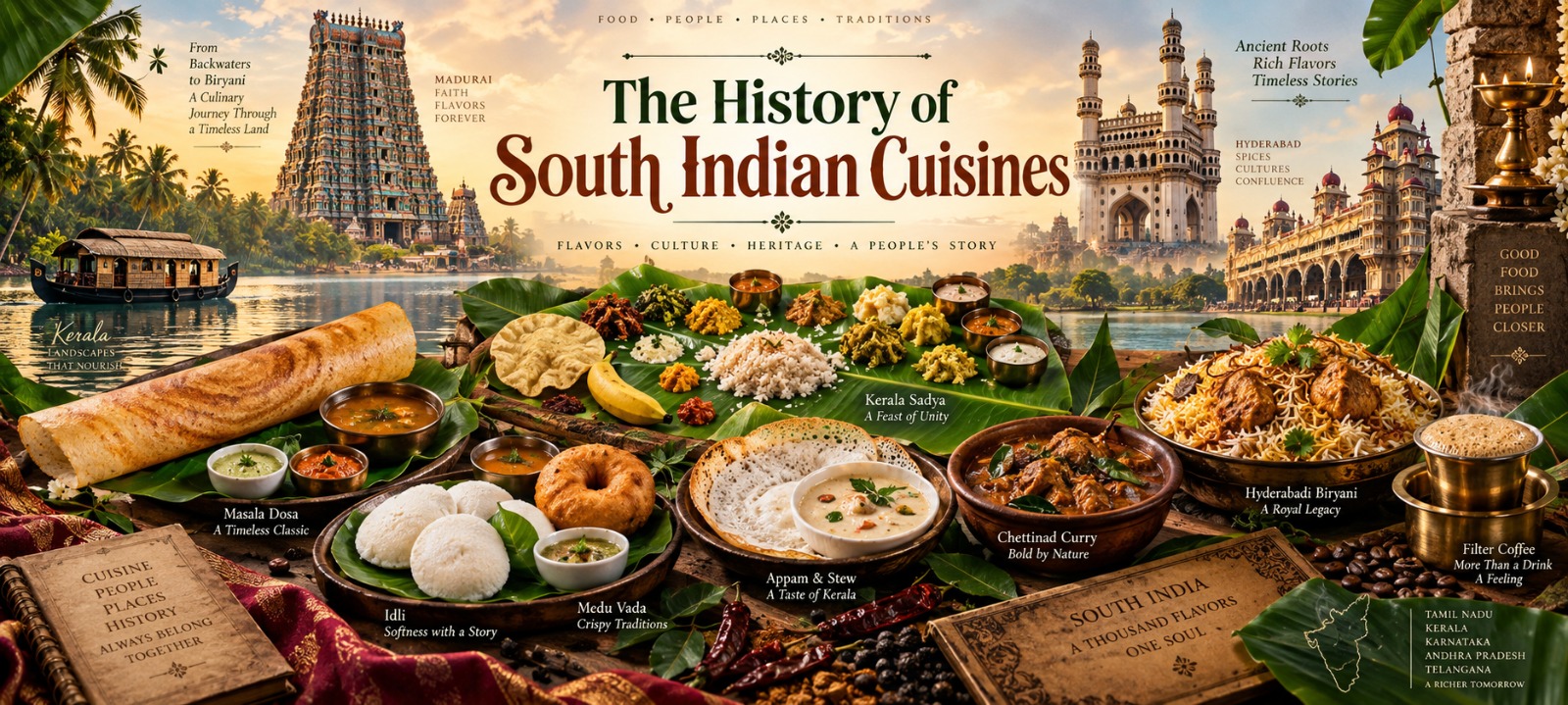
The history of South Indian cuisine is more layered than most people assume. Ask five people what “South Indian food” means and you’ll get five different answers, dosa and idli, fiery Andhra curries, coconut heavy Kerala fish preparations, or the pepper driven intensity of Chettinad. All five are right, and all five are incomplete. South India isn’t one cuisine wearing three regional costumes, it’s three (at least) distinct culinary histories that happened to develop on the same coastline, shaped by different trade routes, different rulers, different soil, and different relationships with spice.
We’ve already gone deep on each region individually:
This post is the map that ties those three together, where they came from, how they diverged, and what actually makes a Chettinad kitchen different from a Kerala one or an Andhra one, side by side.
Why the History of South Indian Cuisine Split Into Three Directions
All three sit in South India. All three lean on rice as a staple. All three use curry leaves, mustard seeds, and tamarind. And yet a Chettinad pepper chicken, a Kerala fish moilee, and an Andhra gongura mutton could not be mistaken for each other. The reasons come down to three forces that shaped the history of South Indian cuisine differently in each region:
Trade routes. Chettinad’s merchant community historically traded across Southeast Asia and Sri Lanka, which is part of why Chettinad cuisine carries spice combinations and techniques (like the heavy use of star anise and stone flower) that are rarer elsewhere in Tamil Nadu. Kerala’s coastline was a spice trade hub for centuries, Arab, Chinese, and European traders all left marks on how Kerala cooks use pepper, coconut, and vinegar.
Geography. Kerala’s backwaters and coastline built a cuisine around coconut, seafood, and rice. Andhra’s drier interior and river deltas built a cuisine around chilies, tamarind, and lentils, with far less coconut than Kerala. Chettinad’s arid, inland geography pushed cooks toward intensely spiced, long shelf life preparations using dried spices ground fresh.
Historical rule and community structure. Andhra cuisine carries a clear split between the Nizami influenced Hyderabadi style (Mughlai rich, dum cooked, subtly spiced) and the fierier Telugu Andhra style from the coastal and Rayalaseema regions. Chettinad’s naming comes from the Nattukottai Chettiar merchant community specifically, not the wider Tamil Nadu population, which is why Chettinad food reads as its own category rather than just “Tamil food.”
Chettinad vs Kerala vs Andhra: A Side by Side Comparison
The table below summarizes the history of South Indian cuisine across all three regions at a glance:
| Chettinad | Kerala | Andhra | |
|---|---|---|---|
| Signature heat source | Freshly ground black pepper, dried red chilies, star anise | Green chilies, black pepper (historically the spice) | Dried red chilies, often the hottest of the three |
| Fat used | Gingelly (sesame) oil | Coconut oil | Peanut oil or gingelly oil |
| Coconut use | Occasional, in specific dishes | Central, fresh grated coconut in most curries | Minimal to none |
| Souring agent | Tamarind, tomato | Tamarind, kokum (in some coastal dishes), raw mango | Tamarind, heavily |
| Signature dish | Chettinad chicken/pepper chicken | Fish moilee, sadhya | Gongura mutton, Andhra chicken curry |
| Rice preparation | Steamed rice, kozhukattai (rice flour dumplings) | Kerala matta rice, appam | Steamed rice, biryani (Hyderabadi) |
| Festival food anchor | Naivedhyam for Vinayagar Chaturthi | Onam sadhya | Ugadi pachadi, festival pulihora |
What This Means If You’re Cooking or Ordering South Indian Food
If a menu or a home cook says “South Indian,” ask which region, because the answer changes everything from the fat used to the heat level to how long the dish takes to make. A Kerala sadhya and a Chettinad naivedhyam are both South Indian festival spreads, but they share almost no dishes in common. An Andhra chicken curry and a Chettinad pepper chicken both use dried red chilies, but the tempering, the oil, and the finishing technique are entirely different.
This is exactly why we build our menu by region instead of bundling everything under one “Indian food” label, a home cooked Chettinad tiffin should taste like Chettinad, not a compromise between three traditions.
Explore Each Region in Depth
- Read the full History of Chettinad Cuisine, on merchant trade routes, gingelly oil, and pepper heavy technique.
- Read the full History of Kerala Cuisine, on the spice trade, coconut, and the sadhya tradition.
- Read the full History of Andhra Cuisine, on the Nizami and Telugu split and the region’s reputation for heat.
Order Authentic South Indian Food in Maryland
If reading about the differences made you want to actually taste them, Shero Home Food makes home cooked South Indian food by region, not a blended version, across Rockville, Gaithersburg, Columbia, Ellicott City, and College Park. Browse Shero’s South Indian menu or subscribe to a weekly tiffin plan to try Chettinad, Kerala, and Andhra dishes made the traditional way.
Leave a Reply