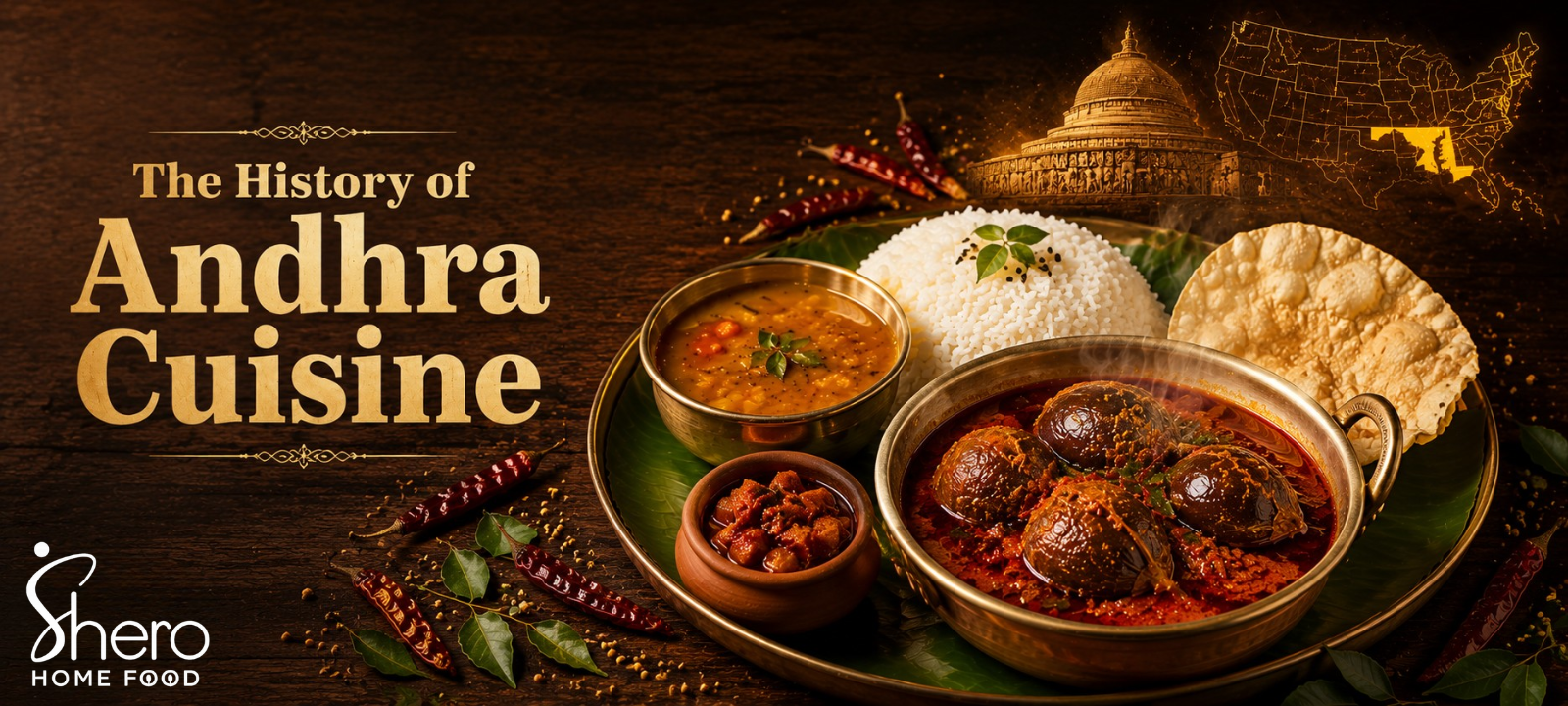
Andhra cuisine is not built to ease you in. If you’ve typed andhra food near me into Google and landed on generic “Indian restaurant” listings, you already know the problem: most menus simply aren’t built for it. It’s the one regional Indian cuisine that treats “mild” as a failure state. That reputation isn’t an accident of taste, either. It’s the result of geography, agriculture, and royal history that pushed Telugu cooking toward heat, tang, and preservation long before refrigeration existed.
Where Did Andhra Cuisine Originate?
Andhra cuisine comes from the historical Andhra region of South India, today split largely between Andhra Pradesh and Telangana, anchored by the fertile deltas of the Godavari and Krishna rivers. This is one of the richest rice-growing belts in the country, and rice is the backbone of nearly every Andhra meal: served with a dozen accompaniments, folded into pulihora (tamarind rice), or ground into the batter for pesarattu.
The cuisine’s identity was shaped under two major dynasties, the Kakatiyas (12th to 14th century) and later the Vijayanagara Empire, whose courts patronized elaborate vegetarian and non-vegetarian feasts, and whose temple towns (Srisailam, Simhachalam) still preserve prasadam traditions that influenced everyday Andhra cooking. Later, the Nizams’ Hyderabad state added a distinct Mughlai-Telugu fusion in the Telangana region, giving rise to what most people outside India now recognize first: Hyderabadi dum biryani.
Why Andhra Food Is So Spicy: The History Behind the Heat
The heat in Andhra food isn’t decorative; it’s practical. Before refrigeration, Telugu households in a hot coastal climate relied on chillies, tamarind, and salt as preservation tools as much as flavor. Guntur, in Andhra Pradesh, grows some of the hottest and most widely traded chillies in India (the region is still one of Asia’s largest chilli trading hubs), and that local abundance shaped the cuisine directly. It’s part of why real andhra food near me is so hard to replicate outside a Telugu kitchen.
Pickles (avakaya, gongura pachadi, mango pickle) were built to last months without spoiling, using enormous quantities of chilli and oil as a preservative barrier. Even everyday dishes carry that same instinct: a simple dal becomes gongura pappu, souring and heating it with sorrel leaves; a chutney becomes a fire-forward accompaniment rather than a garnish. Andhra food doesn’t hide behind coconut milk or cream the way some neighboring cuisines do, since the spice is meant to be tasted directly.
Signature Andhra Dishes and Their Stories
| Dish | What It Is | Why It Matters |
|---|---|---|
| Gongura Pachadi / Gongura Mutton | Sorrel-leaf chutney or curry, intensely sour and spicy | The most iconic Andhra flavor, a taste almost nobody outside Telugu households replicates correctly |
| Andhra-Style Chicken/Mutton Biryani | Rice layered with a fiery masala, distinct from the milder Hyderabadi dum style | Shows the split between coastal Andhra’s direct heat and Telangana’s Nizami restraint |
| Pesarattu | A green-gram (moong dal) crepe, often served with upma inside | Andhra’s answer to the dosa, a breakfast staple built on a different lentil entirely |
| Pulihora | Tamarind rice tempered with mustard, curry leaves, and peanuts | A temple-prasadam dish turned everyday comfort food; it travels well, which made it a household and festival staple |
| Avakaya | Raw mango pickle packed with chilli powder and gingelly oil | Possibly the most famous Andhra pickle worldwide; a single jar can define a household’s reputation for cooking skill |
Each of these dishes reflects the same underlying logic: rice as the canvas, chilli and tamarind as the defining forces, and a refusal to dilute flavor for comfort. It’s also exactly why a search for andhra food near me rarely turns up anything this specific.
Why “Andhra Food Near Me” Is Hard to Find in Maryland
The Telugu diaspora in the US is one of the largest and fastest-growing Indian-American communities, heavily concentrated in tech corridors, and Maryland’s Montgomery, Howard, and Prince George’s counties fall squarely in that footprint. Groups like the Telugu Association of Maryland and the Capital Area Telugu Society reflect a community large enough to sustain its own cultural calendar, yet authentic Andhra food delivery in Maryland remains surprisingly hard to find.
Most Indian restaurants serving the DMV area default to a generalized “South Indian” menu (dosa, idli, a mild sambar) that skips past Andhra’s specific identity almost entirely. Gongura, Andhra-style biryani, and pulihora rarely appear on a restaurant menu built for broad appeal, because they’re built for a Telugu palate, not a crowd-pleasing one. Anyone typing andhra food near me or telugu food near me into search and landing on generic “Indian” results is hitting a real, structural gap, not a fluke.
How Shero Brings Real Andhra Cooking to Maryland
Shero Home Foods works with home cooks, including cooks trained in authentic Andhra and Telugu household traditions, to bring genuine home-cooked Indian food delivery to Telugu families and students across Maryland. This is the andhra food near me answer most searches miss. Rather than a restaurant softening Andhra food into something more broadly palatable, Shero Home Foods connects you directly with a kitchen partner who cooks gongura pachadi, Andhra-style biryani, and pulihora the way a Telugu household actually makes them: full heat, real tamarind, no shortcuts.
If you’ve been searching Maryland for andhra meals near me or authentic telugu tiffin that tastes like it came from Guntur or Vijayawada rather than a general Indian restaurant menu, that’s exactly the gap Shero is built to close, for families in Rockville, Gaithersburg, and Columbia, and for Telugu students near College Park looking for a taste of home. So the next time you search andhra food near me, this is the answer worth finding.
Browse more Telugu recipes and stories on our blog, or go straight to ordering below.
Leave a Reply