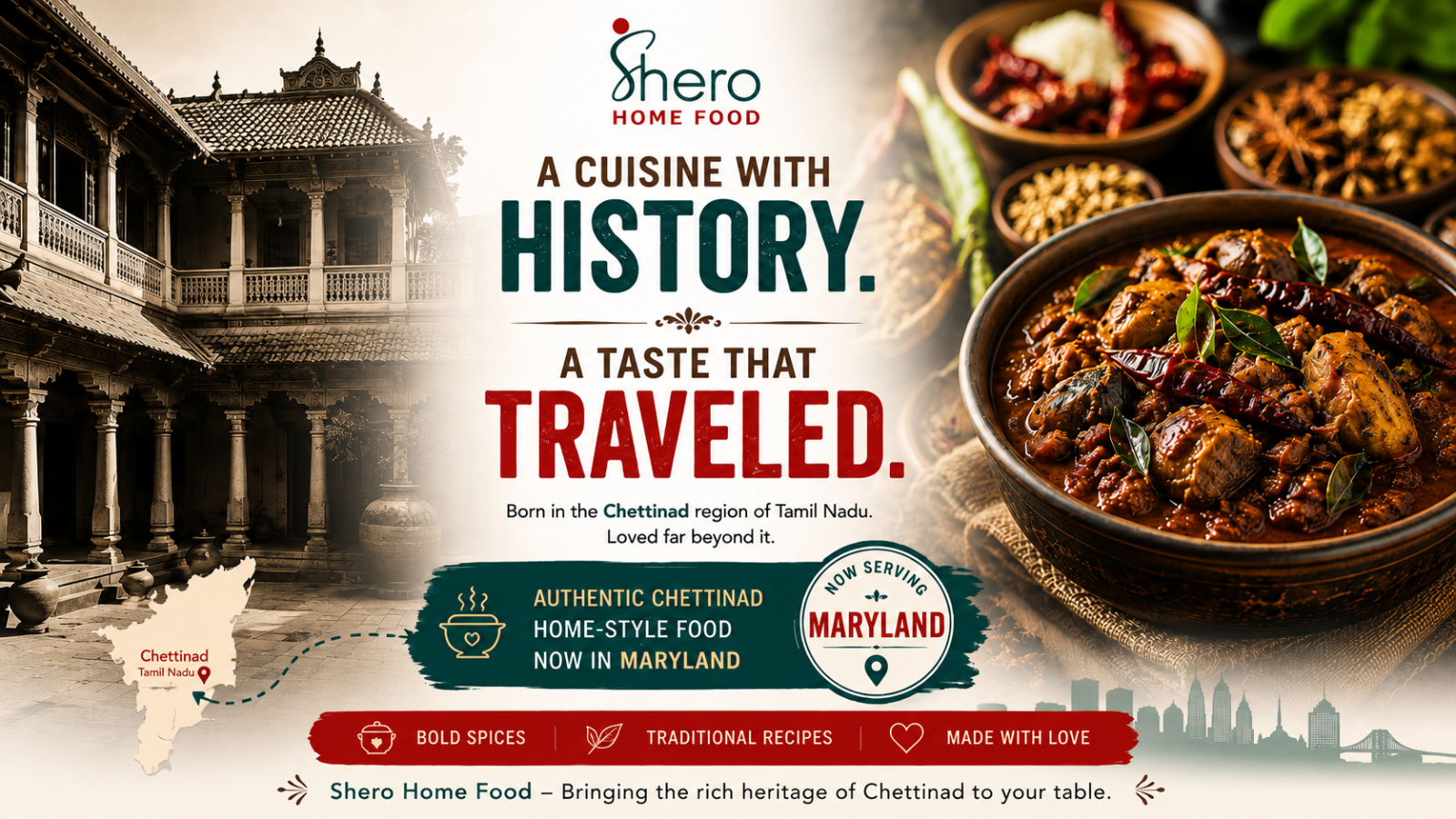
Chettinad cuisine originated with the Nagarathar merchant community of Tamil Nadu’s Chettinad region, whose centuries of spice trading with Southeast Asia, Burma, and Ceylon built one of India’s most complex spice traditions. Known for dishes like Sambar, Rasam, and kaara kuzhambu, this cuisine is now finding a new home among the Indian diaspora in Maryland, where demand for authentic Indian food delivery in Maryland is outpacing supply from mainstream restaurants.
If you’ve ever eaten a curry so layered with spice it seemed to unfold in stages, pepper first, then fennel, then a slow heat that lingers, you’ve likely encountered Chettinad food. It’s one of India’s most distinctive regional cuisines, and its story starts not in a home kitchen, but on a trade route.
Where Did Chettinad Cuisine Originate?
Chettinad cuisine comes from the Chettinad region in Sivaganga district, Tamil Nadu, home to the Nagarathar (Chettiar) community. The Nagarathars were not farmers, they were bankers and merchant traders who, from the 19th century onward, built trading networks stretching across Burma, Malaysia, Singapore, Vietnam, and Ceylon.
That matters because cuisine follows trade. As Chettiar merchants traveled and returned, they brought back spices, techniques, and ingredients rarely used elsewhere in South India: dried Kashmiri chillies, star anise, marathi moggu (a dried flower bud used nowhere else in Indian cooking), and stone ground masalas built from 15 to 20 ingredients rather than the 5 to 6 typical of neighboring Tamil kitchens.
Because the Nagarathars were often away for months on business, their households, run by the women of the family, developed food that could be prepared in bulk, stored, and served to large joint families and constant guests. That’s the origin of Chettinad’s iconic dry spice powders, pickles, and slow simmered gravies: practical food for a trading dynasty, built to feed extended households.
The Spice Trade Legacy Behind the Heat
Chettinad food’s reputation for heat isn’t decorative, it’s structural. Merchants returning from Malabar and Southeast Asia brought home black pepper, star anise, and stone flower (kalpasi) in quantities unavailable to inland Tamil communities. Combined with locally grown red chillies, this created a layered heat profile: an immediate chilli burn, followed by the warmth of pepper and fennel, and a lingering aromatic finish from spices like anise and cinnamon.
The other signature technique is dry roasting whole spices before grinding, a method that intensifies aroma without the bitterness raw grinding can produce. This single step is why Chettinad masala tastes fundamentally different from a standard South Indian sambar powder, even when several ingredients overlap.
Signature Chettinad Dishes and Their Stories
- Chettinad Chicken (Kozhi Varuval) — Chicken simmered in a roasted spice masala with coconut and curry leaves. The most internationally recognized Chettinad dish; a benchmark for judging a kitchen’s spice grinding skill.
- Kaara Kuzhambu — A fiery tamarind based gravy, often meat free, built for rice. Everyday household food, shows Chettinad cooking wasn’t only for feasts.
- Meen Kuzhambu — Tamarind fish curry with mustard and fenugreek. Reflects trade era access to coastal fish and Southeast Asian souring agents.
- Chettinad Pepper Chicken — Dry roasted chicken finished in cracked black pepper. Direct legacy of the pepper trade the Nagarathars controlled.
- Paal Paniyaram — Sweet dumplings soaked in coconut milk. Shows the community’s parallel tradition of elaborate festive desserts.
Each dish carries a piece of trade history: the tamarind and coconut of coastal Tamil Nadu, the pepper of Malabar, and the dried spices that came home in a merchant’s trunk rather than a local farmer’s field.
Chettinad Cuisine in America Today
For Indian origin families and international students now living in the US, Chettinad food occupies an odd gap. It’s widely loved, Chettinad chicken shows up on the menu of nearly every Indian restaurant from New York to Houston, but the version served is frequently simplified: fewer spices, less roasting time, and a heat level dialed down for a broader audience.
For Indian diaspora communities in Maryland specifically, the challenge isn’t finding an Indian restaurant. It’s finding authentic Indian food cooked the way a Chettinad household would actually make it, hand ground masalas, proper dry roasting, and the kind of slow simmered kuzhambu that doesn’t work on a 15 minute restaurant ticket time. Restaurant kitchens optimized for speed and broad appeal structurally can’t replicate what a home kitchen does by default.
This is where home cooking has an advantage restaurants don’t: time, patience, and a recipe passed down rather than standardized for a menu, which is exactly what you’ll find with home cooked Indian food near you through Shero’s kitchen partner network.
How Shero Brings Real Chettinad Cooking to Maryland
Shero Home Foods works with home cooks, including cooks trained in authentic Chettinad and other South Indian regional traditions, to bring genuinely home style Indian food delivery to the Maryland Indian diaspora and university communities across the state. Rather than a restaurant reproducing a diluted version of Chettinad chicken, Shero’s model connects you directly with a kitchen partner cooking it the way it’s meant to be made: dry roasted spices, hand ground masala, and the layered heat that defines the region.
If you’re in Maryland and have been searching for Chettinad food near me or authentic South Indian food that tastes like it came from a Tamil Nadu kitchen rather than a commercial menu, that’s exactly the gap Shero is built to close.
Order Chettinad-style meals in Maryland → shero.us
Leave a Reply