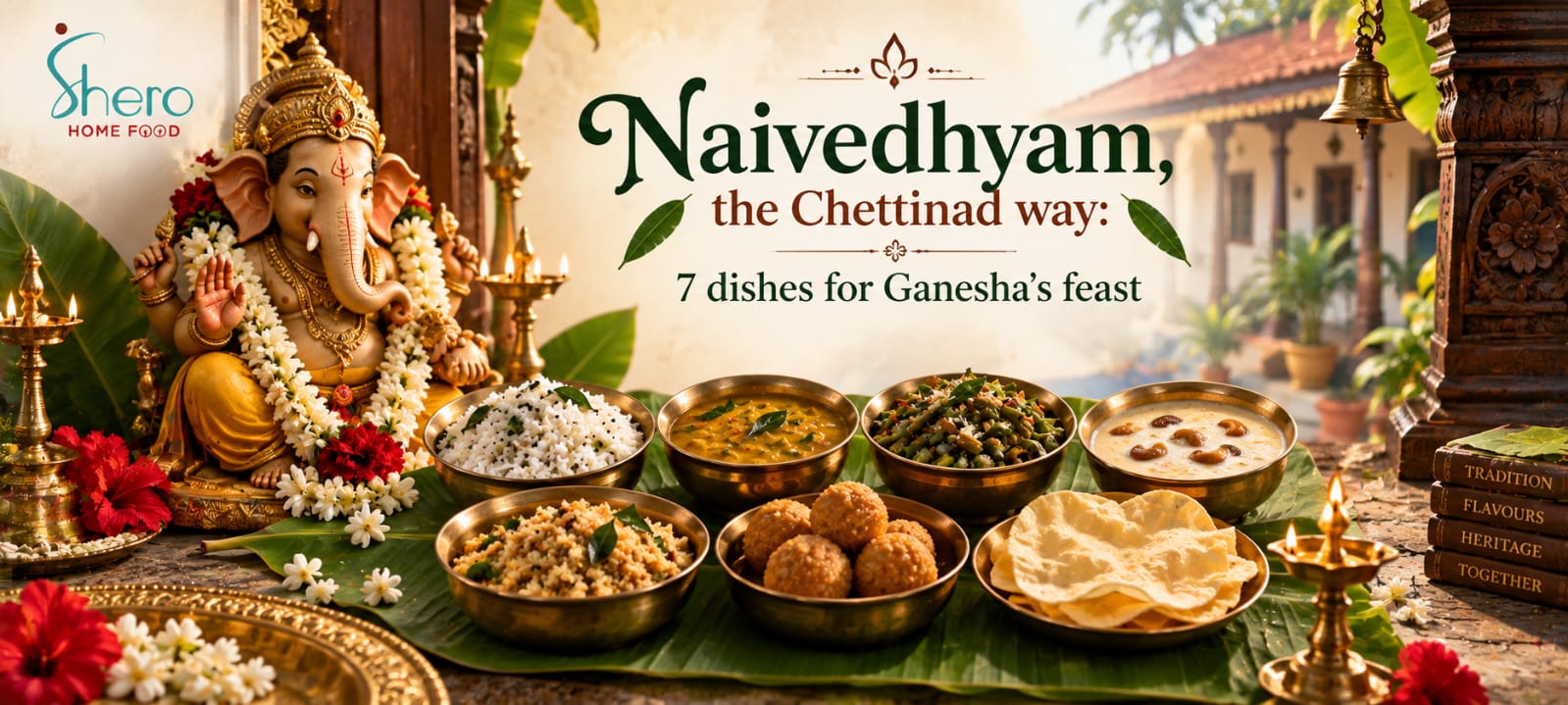
Chettinad naivedhyam isn’t just “South Indian festival food,” it has its own grammar. Every year, as Vinayagar Chaturthi approaches, the same question echoes through Chettinad households across the Maryland DC diaspora: what should go on the naivedhyam plate this year? If you grew up watching your paati grind rice for kozhukattai the night before, or waited for the first sundal to cool enough to eat, you already know that a proper Chettinad naivedhyam spread is one of the richest traditions inside Ganesh Chaturthi celebrations across India and the diaspora.
What Makes Chettinad Naivedhyam Different
Most regional prasadams lean on a handful of shortcuts, store bought spice powders, a single lentil, coconut used almost as an afterthought. Chettinad cuisine refuses all three, and that same philosophy carries straight into its naivedhyam.
- Freshly ground spices, every time. Even a “simple” sundal in a Chettinad kitchen gets its tempering from spices dry roasted and ground that morning, not from a jar. The flavor difference is immediate, sharper, warmer, less flat.
- Specific lentil combinations, not just “dal.” Where other regional traditions might default to toor dal across the board, Chettinad naivedhyam pairs particular lentils to particular dishes, channa for sundal, moong for pongal, toor for payasam, because each lentil behaves differently with jaggery, ghee, and heat.
- Coconut and jaggery used with intention. Freshly grated coconut goes into the poornam, the sundal, and the payasam, but never in a way that overwhelms the lentil or rice base underneath it.
This is exactly the kind of home cooked, made from scratch approach that gets lost the moment a dish is made ahead in bulk for a restaurant menu, which is why, for a lot of Chettinad families in Rockville, Gaithersburg, Columbia, Ellicott City, and College Park, a real Chettinad naivedhyam is one of the few times all seven of these dishes appear on one table in the same year.
Below are the seven dishes we consider essential to a Chettinad naivedhyam spread for Vinayagar Chaturthi, what each one is, why it belongs on the plate, and where to go for the full recipe. For more festival guides like this one, see our full recipe archive on the Shero blog.
The 7 Dishes
1. Kozhukattai (Poornam Kozhukattai)
The dish most people picture first when they hear “Vinayagar Chaturthi recipes.” A soft outer casing made from steamed rice flour dough, folded by hand into pleated pouches and filled with poornam, freshly grated coconut cooked down with jaggery and a whisper of cardamom. Lord Ganesha’s favorite, by tradition, and the anchor dish of the entire naivedhyam thali.
2. Ellu Kozhukattai (Sesame Filled Kozhukattai)
A lesser known cousin of the classic kozhukattai, using the same rice flour outer but swapping the coconut jaggery filling for one built on roasted sesame seeds and jaggery. Nuttier and slightly denser than the poornam version, it’s a Chettinad household staple that rarely makes it onto restaurant menus, which makes it one of the most distinctive dishes on this list.
3. Chettinad Style Sundal
Not the mild, boiled and tempered sundal found elsewhere, Chettinad sundal gets its identity from a fresh coconut, chili, and curry leaf tempering ground just before cooking, layered onto channa or peanuts. It’s typically the dish that anchors the savory side of naivedhyam, balancing out the sweetness of the kozhukattai and payasam.
4. Ven Pongal
The classic offering to open or close the naivedhyam, a savory rice and moong dal porridge tempered generously with ghee, cumin, black pepper, and curry leaves. In Chettinad kitchens, the ratio of rice to dal and the amount of pepper are both taken seriously; too little pepper and it reads as bland, too much and it overwhelms the ghee. This dish also sits inside the broader pongal family celebrated across Tamil cuisine.
5. Paruppu Payasam
The sweet counterpart to ven pongal, and arguably the most labor intensive dish on this list. Toor dal is cooked down until it nearly dissolves, then simmered with jaggery and thick coconut milk, finished with cardamom and a ghee fried cashew raisin tempering. Done right, it should taste rounded and mellow, never gritty, never separated. It belongs to the wider payasam tradition of South Indian festival sweets.
6. Vella Seedai / Uppu Seedai
Deep fried rice flour dumplings, one batch sweetened with jaggery (vella seedai), one salted (uppu seedai), that are practically synonymous with Vinayagar Chaturthi in Chettinad and greater Tamil households. The dough has to be handled precisely; too much moisture and the seedai burst in hot oil instead of turning crisp and hollow centered.
7. Kara Kolukattai (Ulundu Kozhukattai)
The spiced, savory cousin of the sweet kozhukattai, the same rice flour outer, but filled with a coarsely ground urad dal and spice mixture instead of coconut jaggery poornam. It rounds out the naivedhyam plate with heat and earthiness, a counterpoint to five sweet dishes and one mild pongal.
Building Your Chettinad Naivedhyam Plate
A traditional Chettinad naivedhyam doesn’t need all seven at once, but most families anchor around three or four: kozhukattai (sweet), a seedai variety, sundal, and either pongal or payasam. If you’re cooking for the first time this year, start with poornam kozhukattai and sundal, they teach you the two foundational techniques (rice flour dough, and fresh tempering) that the rest of the list builds on.
Order Chettinad Naivedhyam in Maryland
If your Vinayagar Chaturthi this year is busier than usual, work, kids, guests, and freshly grinding spices for seven separate dishes isn’t realistic, that’s exactly the gap Shero Home Food exists to fill: authentic, home cooked Chettinad food made the traditional way, delivered as part of an Indian tiffin service across Rockville, Gaithersburg, Columbia, Ellicott City, and College Park, so the naivedhyam plate can still be done right without you doing all the grinding yourself.
Looking for south Indian food near you beyond the festival season too? Browse Shero’s home cooked Indian food menu for weekly tiffin plans across Montgomery, Howard, and Prince George’s counties.
Subscribe to Shero’s home cooked meal subscription and get authentic regional Indian food, and a proper Chettinad naivedhyam spread every festival season, on a recurring plan.
Leave a Reply